
06 May 2026
Symptoms of Clogged Fuel Injectors (And How to Clean Them Without a Workshop)
By Atomax Additives
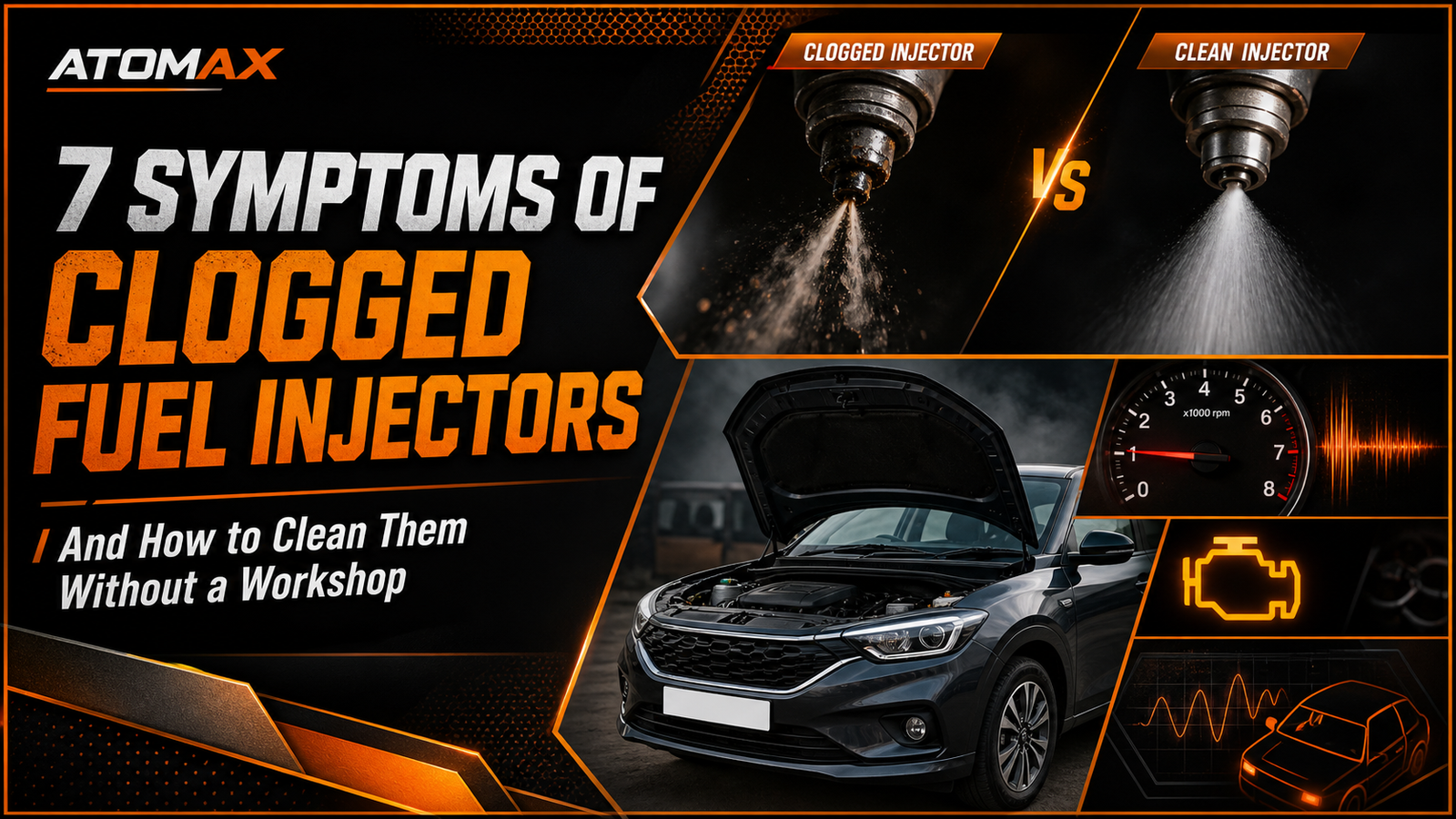
Fuel injectors meter fuel through openings finer than a human hair, dozens of times per second. It takes astonishingly little deposit — a few microns of carbon varnish — to disturb that precision. Because the clogging happens gradually, most owners don't notice until the symptoms stack up. Check your vehicle against this list.
The 7 warning signs
- Rough or uneven idle — the engine vibrates or "hunts" at a standstill because cylinders receive unequal fuel.
- Falling mileage — a 5–15% drop with no other explanation is the classic injector signature.
- Hesitation or stumble on acceleration — the injector can't deliver the sudden extra volume the ECU demands.
- Hard starting — poor atomisation makes the initial fire-up difficult, especially cold.
- Loss of top-end power — the engine feels flat at higher revs where fuel demand peaks.
- Fuel smell or black smoke — a leaking or dribbling injector over-fuels the cylinder.
- Check-engine light with misfire codes (P0300 series) — partial clogs cause intermittent misfires the ECU detects.
Why injectors clog in Indian conditions
Heat soak after shutdown bakes fuel residue onto injector tips; stop-go traffic means injectors spend hours at low, deposit-forming flow rates; and E20 petrol's solvent action carries dissolved old varnish from the tank straight to the injector. Indian driving is close to a worst-case scenario for injector fouling.
Option 1: Workshop injector service
Ultrasonic cleaning involves removing the injectors, cleaning them in a bath and flow-testing them. It's effective but costs ₹1,500–4,000 plus labour, requires the vehicle for a day, and does nothing for the valves and combustion chamber deposits behind the injectors.
Option 2: Additive-based cleaning
A detergent-rich fuel additive cleans injectors in place while you drive, and unlike ultrasonic service, the detergent also cleans intake valves, combustion chambers and the fuel lines feeding the injectors. For light to moderate fouling (the vast majority of cases), two consecutive treated tanks of Atomax restore normal spray patterns; a maintenance dose every 2,000–3,000 km stops the deposits returning. Severe mechanical blockages still need the workshop, but they're rare in vehicles that clean regularly.
The smart sequence
Try the additive route first: it costs a fraction of workshop service and resolves most cases. If symptoms persist after two treated tanks, you've spent little and can go to the workshop with useful diagnostic information.